How to Get Out of My Parents Family Phone Plan
The parents who track their children

Child-tracking apps are growing. Although they assist parents go on tabs, are they hurting families in in commutation for peace of listen?
Eastward
Elaine Spector was anxious to hear whether her son had safely gotten back to his dorm in Texas, afterwards a recent visit domicile. But rather than waiting for him to call or text, the Baltimore, U.s.-based mum was carrying on with her day, and awaiting a reassuring ding from her phone.
That'southward because, like 32 million people around the earth, Spector and her whole family unit have Life360 installed on their phones. The app keeps constant tabs on the whereabouts of her 3 children, letting her know when they're on the move, when they're safely domicile, if they're somewhere they shouldn't be and a whole host of other data. "They got to school, ding. They got home, ding," says Spector, a patent attorney. "Information technology's merely a way for us to know as a family where everybody is."
The family unit have used the app for several years now, and Spector says while her younger children tend to plow off their locations at times, her oldest son has always been relaxed almost using it. Merely even though he is now 18 and living across the country, she admits the thought of him removing the app and taking away those reassuring dings "makes me feel stressed". "I don't desire to be the helicopter parent, simply we've had this for a while, and at that place'southward a part of me that'southward hesitant to totally cut it off," she says. "I like this subtle role of, 'he's safe and I don't need to pester him'."
Family-tracking apps accept exploded in popularity over the past decade or then. A parent's natural instinct to protect their children is a component of growth, of course – but these apps go on booming as many parents feel the globe – both off and online – is inherently and increasingly dangerous.
Yet experts say parents wanting to use them should remember very difficult about how they''ll practise and so, and how they'll talk to their children well-nigh them. Apps are becoming always more sophisticated in the data they're gathering, raising questions about personal security. And children raised being app-monitored are now reaching adulthood, leaving the parents with the quandary – when practise you lot turn them off?
Geofencing, speed monitoring and more
While Life360 dominates the family unit tracking market – information technology's currently the sixth most downloaded social media app on the iOS App store in both the United kingdom and US – there is a vast array of software available, all offering parents varying degrees of monitoring.
Ghislaine Bombusa, caput of digital at UK-based Internet Matters, which advises parents on net safety, says there are essentially two types of tracking options. The option betwixt the 2 "depends on your type of parenting, in terms of how closely y'all want to monitor your kid".
The simplest are location-sharing apps, which come installed on phones like Find My Friends on iOS devices, or Google Family for Android. There are also third-party apps that enable users to gather a seemingly limitless range of data from connected phones.
At the bones end, this includes features such equally geofencing, and then an alarm is sent when a phone leaves or enters a sure expanse. For parents with teen drivers, there's too speed monitoring and crash detection – something Spector says she has found particularly useful. On the more farthermost end of the marketplace, apps similar FindMyKids allow a parent to remotely activate the microphone on their child's phone and even tape sound, while TeenSafe boasts a "stealth mode" which, says the company, means the child will "never find out that their parents are tracking them".
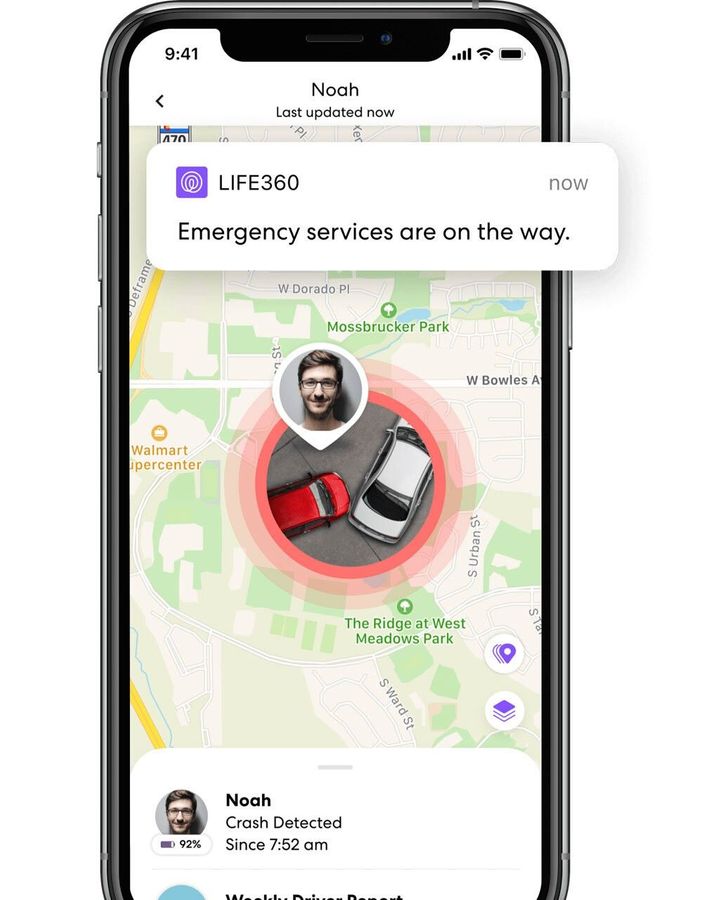
Apps such every bit Life360 can offer a range of services, including monitoring driving (Credit: Life360)
Family Tree
This story is role of BBC's Family Tree serial, which examines the issues and opportunities parents, children and families face today – and how they'll shape the world tomorrow. Coverage continues on BBC Futurity.
Beyond physical tracking, apps tin can also manage a child'south digital life, "whether it'due south what they're spending if y'all've got an allowance online, how they utilize gaming consoles, when they're using information technology", says Bombusa. Apps like OurPact permit a parent to meet screenshots of their child's online interactions, while Bark really scans their messages to alert parents to "apropos interactions".
While Bombusa doesn't believe all parents are now using such apps, she says their proliferation and the amount of investment in them is certainly indicative of high demand. Ane 2019 survey of parents and guardians in the UK found that xl% were using some kind of GPS tracking on a daily basis.
And they are big business. Life360 alone has been valued at over $1bn, and operates in more than than 140 countries. While many apps do have free options, most also offer the option of upgrading to paid accounts for boosted features or to connect more devices. Circle for example, which monitors internet employ, starts at $9.99 (£7.39) a month, and TeensSafe'south five-device plan is currently $99.99 a month.
Data versus trust
Location tracking apps market place themselves equally essential parenting tools in a world full of danger. They rely on parents believing that as long every bit they know where their child is, they volition be safer, or that kids volition steer clear of risky behaviour if they know they're being watched. And at that place have certainly been cases in which parents have used tracking apps to find teenagers who have had an accident, or even been abducted.
But Sonia Livingstone, a professor in the department of media and communications at the London School of Economics and Political Science, believes there is in fact "goose egg prove that whatsoever of these apps continue children safer". "I've never seen any and I await at all the evidence," she says.
As an proficient in children's digital rights and safety, who has written several books about parenting in the digital historic period, Livingstone feels the extensive adoption of tracking apps is an understandable response to constant headlines almost the "terrible dangers to our children". But she argues that in the longer term, tracking apps can accept "unintended but also damaging consequences", non least to the parent-child relationship.
App makers and advertisers may be keen to make parents believe getting an app is an act of parental love, she says, but "the nearly important thing for development is that the kid learns to trust the parent and the parents the child". Relying on an app to discover out where a child is or what they are looking at online, particularly without their knowledge, tin seriously undermine that trust, she says, which might atomic number 82 children to make riskier choices or get clever virtually evading detection. Likewise as the right to exist condom, children do also take a right to privacy, peculiarly equally they get older, says Livingstone.
Yous certainly don't accept to look far to find teenagers – and even older individuals – who feel their parents are encroaching on those rights, or are unwilling to let get of the digital reins. Particularly, Reddit is full of stories about young people who feel constrained past their parents' anxious remote monitoring.
One recent post in the Insane Parents subreddit read: "My mom saw my location was turned off in Life360 and threatened to plow off my phone and also told me that I can't drive the car anymore… Oh did I also mention that I'yard 20 years old???" Another in the Life360 subreddit, where users swap tips on how to evade monitoring, said they were 19, but their mum paid for their telephone so was making them download the app. "I'm literally home all the time unless I'k at class, which she drives me to and from. Why does she feel the need to rails my location when I'm merely ever at 2 places?"
Livingstone says there is indeed a real risk that parental monitoring "moves from existence intrusive to abusive". She argues it is "crucial to our autonomy and our personal integrity not to take our every private thought observed. That's what private means."

Parents naturally want to keep their children prophylactic - just some experts debate tracking them could adversely touch on relationships (Credit: Getty)
An additional key concern for Livingstone is the "scary" amount of information that the tech companies backside these apps collect. While Life360 says information technology gives users "full control and transparency" over their data and that settings tin exist tweaked depending on individual'due south preferences, many apps are quite open about sharing information with places like insurance companies. Livingstone believes there is a troubling lack of understanding, fifty-fifty among experts, most how data is used, or how it might exist used in the future.
Spector says she isn't worried "at all" about information collection, and believes the advantages far outweigh any concerns in that surface area. But Livingstone says parents need to recall difficult about not simply the firsthand risks, only how technology might develop over the side by side decade. Data gathered on a vii-year-old today could, theoretically, exist fed into some "vivid algorithm" in the futurity, which discriminates against them based on their historic movements.
"No-one is looking frontwards in that way, so I think parents should really recollect very carefully most giving that access to anybody."
Boundaries and balance
If a parent does experience an app is the right approach for them, however, there are ways to minimise the risks Livingstone highlights.
Bombusa says it'south essential that using an app is something parents and children do together, later an open conversation, and that the child knows it is not replacing their proper, trusting relationship. Make certain each party knows what the technology will do, why you want information technology, what boundaries you are setting and crucially, how the kid is feeling almost it, she adds. Information technology's likewise vital to adapt the utilize of the apps over time, equally a kid grows and needs more independence.
"I think information technology's about the behaviour your child is showing. If they used it when they first got the telephone and they followed the rules… there's maybe a conversation about relinquishing some of those tracking devices. Or maybe saying, 'OK, I'll only track it when I feel like there's a business organisation', rather than all the time."

Experts suggest talking about using the app with your children and modifying its use as they get older (Credit: Getty)
Livingstone, yet, worries that in that location are simply as well many unknowns around what tracking apps are doing to children and their development to recommend their use. "We simply don't know what information technology will exist like for this generation of children to grow up in a globe in which they've always been watched, always been tracked and never got lost and had to recover themselves," she says. "I really do respect parents' anxiety that leads them to think this could be a solution, and I actually invite them to find a unlike one."
Spector is proud her family has the kind of "open dialogue" recommended by Bombusa, so she's never had to "police force" her children's activities. Merely she admits it would exist very hard to give upwardly those regular dings from Life360, and the peace of listen she feels from being able to run across where her children are. "I don't think addicted is an inaccurate discussion, because I think about non having it and I experience information technology makes me feel stressed," she says.
Her oldest son is however happy to have the app for now, "because he knows I'm not stalking him or checking upwards on him", she says. Just she knows the time is coming when she'll lose the dings. "He would tell me if he didn't want it and I would respect that. Information technology would be hard, merely it wouldn't be the commencement hard affair we'd had to do as parents."
Source: https://www.bbc.com/worklife/article/20211105-the-parents-who-track-their-children

Post a Comment for "How to Get Out of My Parents Family Phone Plan"